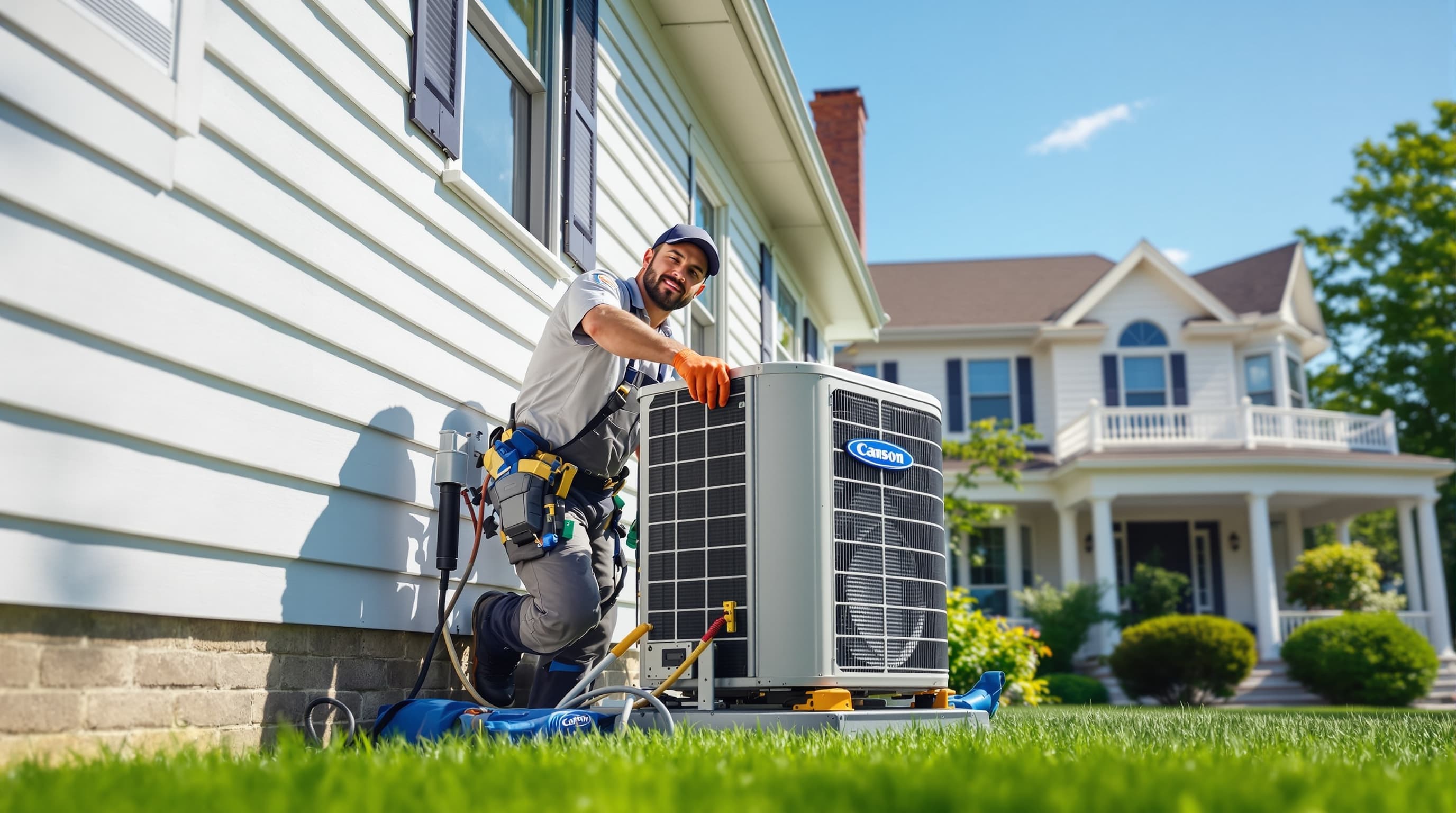
Long Island's climate is unforgiving in both directions. Winters regularly drop into the teens across Nassau and Suffolk County; summers combine 90-degree heat with Atlantic humidity that makes the heat index feel 10 degrees hotter than the thermometer says. An HVAC installation is not a discretionary upgrade here — it is infrastructure. Getting the system type, sizing, and contractor right the first time determines whether you spend the next 15 years comfortable or calling for emergency service.
HVAC Installation Cost on Long Island: By System Type
Installed costs vary widely by system type, home size, and whether existing ductwork is in usable condition. Here are the real 2026 ranges from our completed Long Island installs:
| System Type | Installed Cost (Long Island) | Best For |
|---|---|---|
| Central AC — existing ductwork (SEER2 16) | $4,000 – $8,500 | Homes with working forced-air heat |
| Central AC — new ductwork required | $8,000 – $13,000 | Homes without ductwork or with unusable ducts |
| Ducted heat pump (whole home) | $6,000 – $14,000 | Electric/oil homes wanting heat + cool in one system |
| Ductless mini split — 1 zone | $3,500 – $6,500 | Single room, addition, finished basement |
| Ductless mini split — 3–4 zones | $9,000 – $18,000 | Whole-home solution without ductwork |
| Gas furnace installation | $3,500 – $7,500 | New install or oil-to-gas conversion |
| Oil-to-gas conversion (furnace + hookup) | $5,000 – $11,000 | Nassau and western Suffolk — gas available |
| Oil-to-heat pump conversion | $7,000 – $16,000 | Eastern Suffolk or anywhere gas is unavailable |
All prices include equipment, labor, refrigerant, and permit. Nassau County prices typically run 5–10% above Suffolk due to higher permit fees and prevailing wages in some trade categories.
Mini Split vs. Central Air: How to Decide for a Long Island Home
This is the most common question we get on HVAC installation consultations across Long Island. The answer depends on your home's existing infrastructure.
Central air is the right choice when your home already has functional forced-air ductwork. Most Long Island homes built after 1965 with a gas or oil furnace have ductwork. If the ducts are in reasonable condition (no major leaks or crushed sections), adding a central AC condensing unit and evaporator coil to the existing air handler is a straightforward one-day job. You get whole-home coverage, ceiling register airflow, and a single thermostat. It is also typically the lowest-cost option when ductwork already exists.
Ductless mini splits are the right choice when your home has no ductwork — steam radiators, electric baseboard heat, or radiant floor heat are the most common scenarios on Long Island. They are also the right choice for additions, finished basements, or converted attics where extending existing ductwork would mean opening walls and ceilings. Multi-zone mini split systems can heat and cool an entire home without any ductwork, and they operate at higher efficiency than central air in moderate temperatures.
A hybrid approach works well in many Long Island homes: central AC for the main living area served by existing ducts, plus a mini split for a finished basement or rear addition. We see this frequently in Levittown and Massapequa cape cods where the original home has ductwork but a 1970s rear addition does not. If the addition is not built yet, read up on planning a new home addition so heating and cooling get designed in from the start.
Nassau vs. Suffolk County HVAC Permit Requirements
Every HVAC installation on Long Island requires a permit. The permit process differs meaningfully between Nassau and Suffolk County.
Nassau County has a complex permit structure. The county contains 3 towns but 64 incorporated villages, each with their own building department. A Carrier installation in the Village of Westbury goes through the Westbury Building Department. The same job in unincorporated Westbury (Town of Hempstead) goes through the Town of Hempstead building department. We have pulled permits in all Nassau County municipalities and know which offices move quickly and which ones require follow-up. Nassau permit fees run $100–$400, with the most complex village filings taking 2–3 weeks.
Suffolk County is organized into five towns with independent building departments: Islip, Huntington, Babylon, Smithtown, and Brookhaven. Each town covers multiple hamlets and communities, and unincorporated areas go through the town department directly — no separate village layer. Suffolk permit fees run $75–$250, and inspection timelines are generally shorter than Nassau County, typically 3–10 business days after filing.
We pull the permit before every installation, confirm the inspection date, and have a technician on site for the walkthrough. If an inspector flags anything at rough-in, we address it before the final.
Oil-to-Gas and Oil-to-Heat Pump Conversions on Long Island
Long Island has one of the highest concentrations of oil-heated homes in the Northeast. Estimates put between 40–50% of all Long Island households on oil heat — a legacy of when natural gas infrastructure was limited and fuel oil was cheap. That ratio has been shifting steadily since 2020 as oil prices spiked and PSEG rebate programs made conversion economics clear.
Oil-to-gas conversion makes sense for Nassau County and western Suffolk County homes within reach of the KeySpan/National Grid distribution network. The conversion involves: removing the oil furnace and tank, installing a new high-efficiency gas furnace (95%+ AFUE), connecting to the gas supply line at the meter, and applying for gas service if not already connected. Total installed cost runs $5,000–$11,000 depending on whether the gas line is already stubbed at the house. Annual savings compared to oil heat typically run $800–$1,500 per year at current fuel prices, meaning the conversion pays back in 4–7 years and saves money every year after that.
Oil-to-heat pump conversion is the better path for eastern Suffolk County homes where natural gas is not available — communities like Patchogue, Port Jefferson, Coram, Medford, and most of Brookhaven and eastern Islip. Modern cold-climate heat pumps operate efficiently down to 5°F, which covers all but the coldest Long Island nights. Combined with the federal IRA 25C tax credit (30% of cost, up to $2,000) and PSEG/NYSERDA rebates, the effective cost after incentives is frequently competitive with a straight oil furnace replacement.
For any home on oil heat, we assess the conversion options during every free estimate. We provide a side-by-side comparison of annual operating costs at current fuel prices before recommending a path.
PSEG Long Island Rebates for HVAC Installation
PSEG Long Island (serving most of Nassau and Suffolk County) maintains an active rebate program for qualifying high-efficiency HVAC equipment:
- Central AC (split system, SEER2 16+): up to $650 rebate
- ENERGY STAR Most Efficient heat pump: up to $1,000 rebate
- Ductless mini split (SEER2 16+): up to $500 per indoor unit
- Federal IRA 25C tax credit: 30% of qualifying heat pump cost, up to $2,000/year
- NYSERDA Clean Heating & Cooling: additional incentives for oil-to-heat pump conversions, stackable with federal credit
We handle all rebate applications for qualifying installs. The PSEG rebate check typically arrives 6–10 weeks after submission. We specify SEER2-qualifying equipment on every new installation because the rebate usually more than covers the marginal cost difference over baseline equipment.
Coastal Long Island HVAC: Salt Air and Equipment Selection
Homes within 1–2 miles of the coast — Long Beach, Oceanside, Freeport, Lindenhurst, Babylon, along the South Shore, and Lloyd Harbor, Cold Spring Harbor, and Oyster Bay on the North Shore — face accelerated corrosion on outdoor HVAC equipment. Salt air attacks aluminum condenser fins over copper tubing. Without protection, fins degrade within 5–8 years and restrict airflow, reducing system efficiency and ultimately causing premature compressor failure.
For any installation within 1.5 miles of tidal water, we specify equipment with factory-applied coil coatings (BlueEvolution, LouvreShield, or equivalent) or apply an aftermarket sealant at installation. These coatings extend coil life to 12–15+ years in salt-air environments. It adds $150–$300 to the install cost and saves $3,000–$6,000 in premature replacement. We identify coastal risk during every free estimate.
How to Choose a Licensed HVAC Contractor on Long Island
The Long Island HVAC market has a lot of operators — from one-truck independents to large regional companies. Here is what separates a contractor worth hiring from one to avoid:
- 1Holds a Nassau County or Suffolk County Home Improvement Contractor (HIC) license — verify the number on the county website before signing
- 2NATE-certified technicians (North American Technician Excellence) — the industry's highest technical credential
- 3Pulls the building permit — a contractor asking you to pull your own permit is a red flag
- 4Performs a Manual J load calculation before specifying system tonnage — oversized systems short-cycle and fail to dehumidify
- 5Provides a written itemized quote before any deposit — no ballparks, no verbal agreements
- 6Carries at least $1 million in general liability insurance and provides a certificate before work begins
Island Comfort HVAC is a Carrier Factory Authorized Dealer and Lennox Premier Dealer serving all of Nassau and Suffolk County. Our technicians are NATE-certified and EPA Section 608 Universal certified. We carry $2,000,000 in general liability insurance. Every estimate includes a Manual J calculation and a written itemized quote.
Related HVAC Guides
- Central Air Conditioning on Long Island — costs, brands, PSEG rebates, and what to expect
- Furnace Repair on Long Island — diagnostic costs, common failures, and when to replace
- AC Installation in Suffolk County — town permits, costs, and coverage across Islip, Huntington, and Babylon
- Nassau County HVAC Services — AC, furnace, and heat pump services across Nassau County
- Suffolk County HVAC Services — full coverage across Islip, Babylon, Smithtown, Huntington, and Brookhaven
Frequently Asked Questions: HVAC Installation on Long Island
How much does HVAC installation cost on Long Island?
What permits are required for HVAC installation on Long Island?
Should I choose a mini split or central air for my Long Island home?
What PSEG Long Island rebates are available for HVAC installation?
How common are oil-to-gas or oil-to-heat pump conversions on Long Island?
How do I choose a licensed HVAC contractor on Long Island?
Ready to Install HVAC on Long Island?
Free in-home estimates. Written quotes. Manual J sizing. PSEG rebate paperwork handled. We serve all of Nassau and Suffolk County.
Free HVAC Estimate on Long Island
No obligation. Mon–Sat 7–7.