Long Island Central Air Conditioning Installation: What You Need to Know Before You Buy
By Island Comfort HVAC · Updated April 2026
Long Island central air conditioning installation is one of the most common home improvement projects across Nassau and Suffolk County, and also one of the most frequently misquoted. Prices range from $4,500 for a clean condenser swap to $12,000 or more for a full new system in a home without existing ductwork. This guide covers what the job actually involves, what drives the price up or down, how permits work differently in Nassau versus Suffolk, and how to qualify for the rebates and tax credits that can take a meaningful chunk off your total cost.
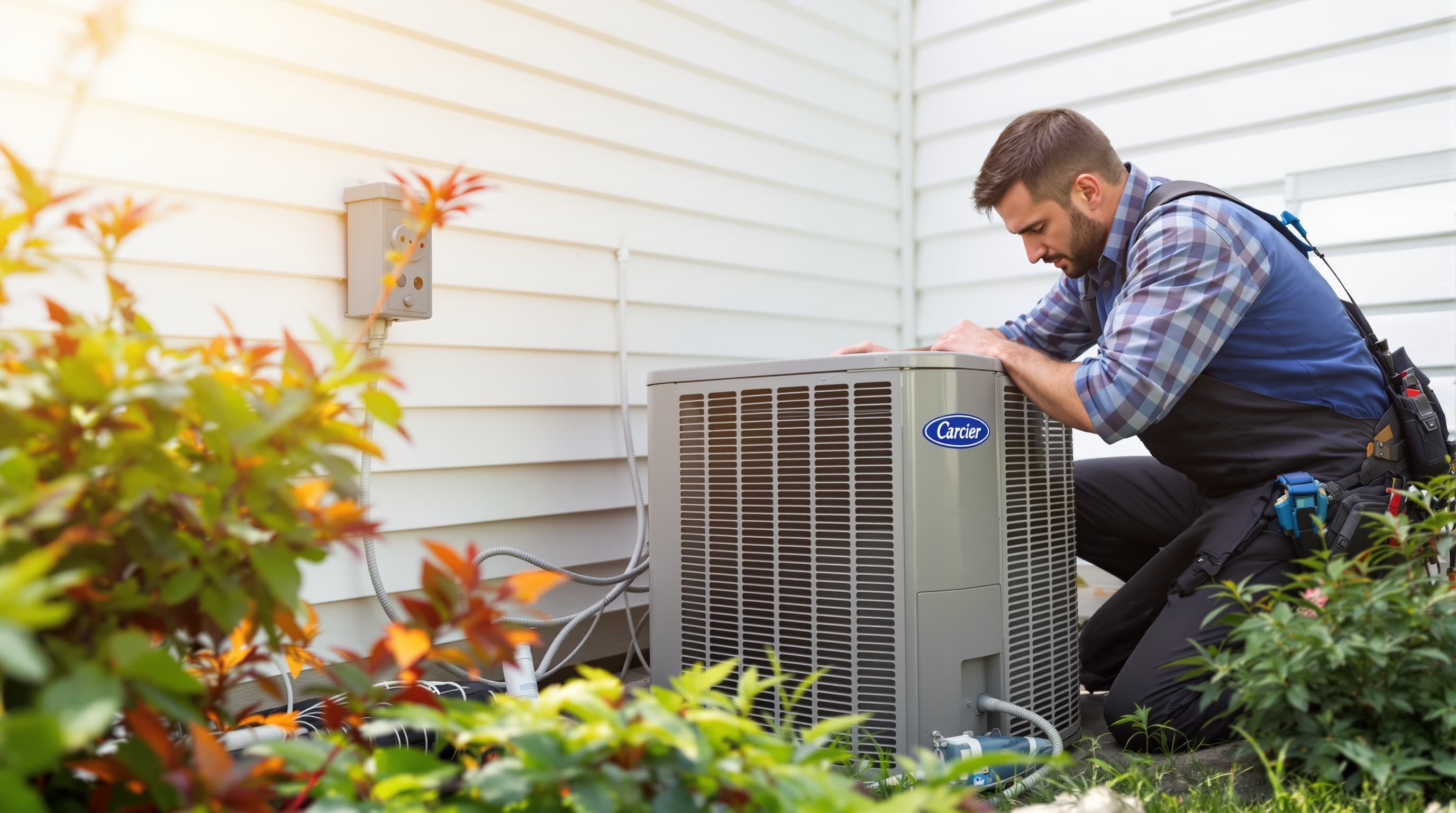
What Central AC Installation on Long Island Actually Involves
A central air conditioning system has two main components: an outdoor condenser unit and an indoor air handler or evaporator coil. The condenser sits outside the house, typically on a concrete pad on the side or rear of the home. The indoor coil sits on top of or inside the air handler, which is usually located in a basement, utility closet, or attic. The two units are connected by copper refrigerant lines (called the line set) and electrical wiring.
When a Long Island contractor talks about a central AC installation, here is what the job typically includes:
- Equipment sizing (Manual J load calculation). Before any equipment gets ordered, a proper contractor calculates the cooling load for your specific home using a Manual J calculation. This accounts for square footage, ceiling height, window orientation, insulation levels, and local climate data. An oversized system short-cycles and leaves the house feeling humid. An undersized system runs constantly and still cannot keep up on 95-degree August days. Insist on a written Manual J with every quote.
- Condenser installation. The outdoor unit gets set on a new or existing concrete pad, leveled, and secured. Local codes in Nassau and Suffolk require the unit to be a minimum distance from property lines and windows, so placement sometimes requires working around landscaping or fencing.
- Line-set routing. The copper refrigerant lines run from the outdoor condenser through the wall or foundation into the mechanical room. On Long Island homes with clay soil and finished basements, this routing can get complicated. Line sets that need to run through finished walls or across long distances add time and cost to the job.
- Evaporator coil or air handler installation. The indoor coil sits on top of the furnace or air handler. If you are replacing just the AC system and keeping the furnace, the coil is swapped out. If you are installing a full system, both components go in together.
- Electrical connections. The outdoor unit requires a dedicated 240-volt circuit. Older Long Island homes, particularly those built in the 1950s and 1960s, may need a panel upgrade or a new dedicated circuit run from the breaker box. This is a common unexpected cost item on older housing stock.
- Ductwork inspection and sealing. Existing ductwork in Long Island homes often leaks 20 to 30 percent of conditioned air before it reaches the living space. A good contractor checks duct connections and recommends sealing as part of the installation. This is not always required but significantly affects system performance.
- Refrigerant charge and system startup. The system gets charged with refrigerant (R-410A for most existing systems, R-454B for newer equipment), and the contractor runs through a startup checklist verifying airflow, refrigerant pressures, electrical draw, and thermostat operation.
For homes that currently have no ductwork at all, the installation also involves designing and running an entirely new duct system, which adds $3,000 to $8,000 to the base equipment cost and extends the job to two to four days.
Free HVAC Estimate on Long Island
No obligation. Mon–Sat 7–7.
Long Island-Specific Considerations Every Homeowner Should Know
Long Island has some quirks that affect how central AC installations are planned and executed. A contractor who primarily works upstate or in the city may not account for all of them.
Salt Air and Coastal Corrosion
The South Shore, barrier island communities (Long Beach, Lido Beach, Fire Island), and waterfront North Shore neighborhoods all deal with elevated salt exposure. Salt air accelerates the corrosion of aluminum condenser fins and can eat through unprotected copper line sets over time. For homes within a mile or two of the water, specifying equipment with a factory-applied corrosion-resistant coating is worth the modest upcharge. Carrier, Trane, and Lennox each offer this on their mid-tier and premium lines. Annual application of a fin protectant spray also helps. This is not a minor concern: a coastal unit without proper protection can show significant fin deterioration within five to seven years.
Clay Soil and Line-Set Routing
Much of Long Island sits on glacial outwash, but large sections, particularly in central Nassau and mid-Suffolk, have heavy clay soil layers. This affects how concrete pads settle under outdoor units over time and can complicate any exterior line-set routing that requires trenching. For above-ground line sets running along the exterior of the home, contractors use line-set covers to protect copper from UV and physical damage, and installation needs to account for the freeze-thaw cycle that affects Long Island from December through March.
LIPA vs National Fuel Gas Territory
Your utility situation matters when planning an AC installation, particularly if you are also considering a heat pump or a gas furnace upgrade at the same time. PSEG Long Island handles electricity billing for most of Nassau and Suffolk under contract with LIPA. However, natural gas service is split: National Fuel Gas serves most of Nassau County and western Suffolk, while KeySpan (now National Grid) serves eastern Suffolk. If your AC installation is paired with a furnace replacement or gas line extension, the specific utility serving your address determines the rebate programs available and the timeline for gas hookup work.
For homeowners on the eastern end of Suffolk, some towns have limited or no natural gas infrastructure, which makes heat pumps and propane systems more common options than gas furnaces.
What Central AC Installation Costs on Long Island
Prices below are installed cost — equipment, labor, permits, and standard materials. They reflect Long Island market rates as of 2026. Nassau County jobs tend to run 5 to 10 percent higher than equivalent Suffolk jobs due to higher local labor rates and longer permit processing times in some municipalities.
| Scenario | Installed Cost Range | Notes |
|---|---|---|
| Condenser replacement (existing ductwork, good condition) | $4,500 – $6,500 | 1-day install; existing coil may also need replacement |
| Full system replacement (condenser + coil, existing ductwork) | $5,500 – $8,500 | Most common scenario for homes built 1970s–2000s |
| New installation — ductwork exists but needs major repair | $7,000 – $10,500 | Duct sealing or partial replacement added to job |
| New installation — no existing ductwork (new duct run) | $9,000 – $12,000+ | 2–4 day job; most complex and expensive scenario |
| Premium equipment tier (Carrier Infinity, Trane XV) | Add $1,500 – $3,000 | Variable-speed compressors, better dehumidification, quieter operation |
What Drives the Price Up
Beyond the basic scenarios above, several Long Island-specific factors push installation cost toward the higher end:
- •Electrical panel upgrades. Homes built before 1975 often have 100-amp or smaller panels that cannot safely add a 240-volt AC circuit. Panel upgrades run $2,500 to $4,500 and are not included in base AC quotes.
- •Difficult line-set routing. Finished basements, tight crawlspaces, or condenser placement on the far side of the home from the mechanical room all add labor hours.
- •R-22 system removal. If you are replacing an older system that still contains R-22 refrigerant, proper recovery and disposal adds $200 to $500 to the job.
- •Coastal corrosion-resistant equipment. Coated condenser models run $400 to $700 more than standard models in the same efficiency tier.
Nassau vs Suffolk Permit Differences
Both Nassau and Suffolk County require permits for central AC installation, but the process works differently enough that it affects project timelines.
In Nassau County, permit authority is fragmented. The county has two towns (Town of Hempstead and Town of North Hempstead), three cities (Long Beach, Glen Cove, and the City of Hempstead), and dozens of incorporated villages, each of which runs its own building department with its own permit application forms and inspection scheduling. The Village of Hempstead has different requirements than the Town of Hempstead unincorporated area. Permits in Nassau typically take one to three weeks to process, and some municipalities require a pre-construction inspection in addition to the post-installation final inspection.
In Suffolk County, permit authority is more consolidated by town. The 10 Suffolk towns — Huntington, Babylon, Islip, Smithtown, Brookhaven, Southampton, East Hampton, Shelter Island, Southold, and Riverhead — each have unified building departments that handle permits for both incorporated and unincorporated areas within the town. Permit processing in Suffolk generally runs faster, often five to ten business days for a residential AC installation permit.
For homeowners, the practical implication is straightforward: your contractor should know the specific permit process for your municipality, not just the county. A contractor who primarily works in Suffolk may not be familiar with the specific requirements of a Nassau village building department, and vice versa. Ask which municipalities they have pulled permits in recently.
Our service area pages for Nassau County and Suffolk County have more detail on municipality-specific permitting and typical project timelines in each area.
Top Brands for Long Island Central AC Installations and Why Contractors Stock Them
Not every brand of air conditioner is equally suitable for Long Island conditions, and not every brand is equally well-supported by the local parts and service network. The three brands that established Long Island HVAC contractors consistently install are Carrier, Trane, and Lennox.
- Carrier. Carrier is the most widely stocked brand on Long Island, partly because of the strength of its authorized dealer network and partly because of local parts availability. When a Carrier unit needs a capacitor, a contactor, or a circuit board at 9 p.m. on a Friday in July, the parts are available next-day from a Nassau County distributor. The Carrier Comfort series covers the standard SEER2 requirements at a competitive price point; the Carrier Performance and Infinity series step up to variable-speed operation and quieter compressor technology. The Infinity 24 heat pump is also one of the most popular cold-climate options for Long Island homeowners transitioning off oil heat.
- Trane. Trane equipment is known for durability in high-humidity coastal climates, which makes it a natural fit for Long Island. The XR series is the workhorse of most contractor recommendations at the mid-tier level. The XV series offers variable-speed compression and is popular for larger homes where consistent temperature control and dehumidification matter as much as cooling capacity. Trane carries a strong warranty structure (10-year on parts for registered equipment), and the brand has consistent contractor training programs in the New York market.
- Lennox. Lennox is the brand most often recommended when quiet operation is a priority. Long Island suburban lots are small enough that a condenser 10 feet from a bedroom window matters. Lennox Signature Series units run at extremely low sound levels (around 59 decibels), which is noticeably quieter than standard compressors. The Dave Lennox Signature Collection also includes some of the most efficient systems available, with SEER2 ratings above 20 for variable-speed models. Lennox is a strong choice for homes in denser Nassau County neighborhoods where outdoor unit noise affects neighbors as much as the homeowner.
All three brands offer SEER2 16+ systems that qualify for PSEG and LIPA rebates. The choice between them typically comes down to contractor relationship (who your contractor is trained and stocked for), budget, and specific performance priorities like noise, humidity control, or variable-speed operation. We are authorized dealers for both Carrier and Lennox. See our central AC installation service page for the specific models we currently install and stock.
SEER2 Minimums, Installation Timelines, and What to Expect on Job Day
SEER2 Requirements Since 2023
The Department of Energy updated its minimum efficiency standards for residential central air conditioners, with the new rules taking effect January 1, 2023. The old SEER (Seasonal Energy Efficiency Ratio) rating was replaced with SEER2, which uses a revised test method that better reflects real-world operating conditions. SEER2 ratings are typically 5 to 7 percent lower than the equivalent SEER rating, so a system that would have been rated SEER 15 under the old standard might now be rated SEER2 14.3.
For Long Island and the broader Northeast, the minimum SEER2 for a new split-system central air conditioner is 14.3 SEER2. Any system below that standard cannot be legally installed as of 2023. Most reputable contractors have fully transitioned their stock; you should not be seeing SEER 14 systems quoted anymore.
For the PSEG or LIPA rebate, you need a system rated SEER2 16 or higher. The premium efficiency tier starts at SEER2 18 and goes up. For most Long Island homeowners, SEER2 16 to 18 represents the best value point: rebate-eligible, meaningfully more efficient than minimum-standard equipment, and not yet at the price premium of the top-tier variable-speed systems.
Typical Installation Timeline
Here is what a standard central AC installation looks like from first contact to operating system:
- 1.Estimate and Manual J sizing: Usually same week or next-week scheduling. Free for most established contractors.
- 2.Permit application: Contractor submits permit application after contract signing. Nassau permits typically take 1 to 3 weeks; Suffolk permits typically take 5 to 10 business days.
- 3.Equipment ordering: Standard models are often in distributor stock. Custom or less common configurations may require 1 to 2 weeks lead time.
- 4.Installation day: 1 day for a condenser swap; 2 to 3 days for a full new system or homes with ductwork complications.
- 5.Permit inspection: Scheduled after installation. Building inspector verifies electrical connections, refrigerant handling, and equipment placement.
- 6.Rebate paperwork: Contractor submits PSEG or LIPA rebate application. Rebate checks typically arrive within 4 to 8 weeks.
From signed contract to operational system, most Long Island AC installations complete in two to four weeks during normal seasons. During peak summer demand (mid-June through August), permit processing times and contractor schedules extend, which is why early spring is the best time to plan a new installation.
PSEG and LIPA Rebates Plus the IRA 25C Tax Credit
Long Island homeowners have access to two meaningful financial incentives for central AC and heat pump upgrades right now. Here is how they work:
PSEG Long Island and LIPA Rebates
PSEG Long Island, acting as the grid operator for LIPA, runs an energy efficiency rebate program that covers qualifying central AC and heat pump installations. Current rebate amounts:
- •Central AC (SEER2 16 or higher): Up to $650. The system must meet ENERGY STAR or equivalent efficiency criteria, and the rebate application is filed by the installing contractor after the job is complete.
- •Heat pump (ENERGY STAR Most Efficient): Up to $1,000. This applies to air-source heat pumps that meet the top tier of ENERGY STAR certification.
Check pselongisland.com/rebates for current program amounts, as rebate levels are adjusted periodically. Your contractor should be familiar with the current program and handle the application paperwork as part of the job. If a contractor tells you they do not handle rebate applications, find a different contractor.
IRA Section 25C Federal Tax Credit
The Inflation Reduction Act expanded the residential clean energy credit for HVAC upgrades. Under Section 25C, homeowners can claim a federal income tax credit of 30% of the installed cost of qualifying heat pumps, up to a $2,000 annual cap. This is a tax credit, not a deduction, meaning it directly reduces your federal tax bill dollar for dollar.
The 25C credit applies to qualifying air-source heat pumps and does not apply to straight-cooling central AC systems. If you are replacing an old gas furnace plus central AC with a heat pump system, you can potentially capture both the PSEG rebate and the 25C credit.
A practical example: a Long Island homeowner installs a $9,500 cold-climate heat pump. They qualify for a $1,000 PSEG rebate (paid by check after the job) and a $2,000 federal tax credit (applied when they file taxes). Net effective cost: $6,500. That is a 32% reduction from the gross project cost.
Long Island Central AC Installation FAQ
How much does central air conditioning installation cost on Long Island?
Most Long Island homeowners pay between $4,500 and $12,000 for a full central AC installation, installed cost. The lower end applies to homes that already have ductwork in decent shape and need a straightforward condenser-and-coil swap. The higher end covers larger homes (2,500+ sq ft), homes that need new ductwork, or installs using premium-tier equipment like a Carrier Infinity or Trane XV series. Nassau County prices tend to run slightly higher than Suffolk due to higher labor rates and stricter permitting timelines.
What is the minimum SEER2 rating required for new AC installations on Long Island?
As of January 1, 2023, federal regulations require a minimum SEER2 of 14.3 for split-system central air conditioners installed in the Northeast, including Long Island. SEER2 is the updated efficiency rating that replaced the old SEER standard. To qualify for PSEG Long Island or LIPA rebates, you generally need a system rated SEER2 16 or higher. Most contractors stock systems at SEER2 16 to 18 as their standard offering since the rebate-eligible systems are only marginally more expensive.
Do I need a permit for central AC installation in Nassau County vs Suffolk County?
Yes in both counties, but the process differs. Nassau County municipalities each run their own building departments — the Village of Hempstead, the Town of North Hempstead, and incorporated villages all have separate permit applications and inspection schedules. Expect permit timelines of 1 to 3 weeks in Nassau. Suffolk County towns tend to operate with more consolidated building departments, and permits often come through faster, sometimes within a week for straightforward AC replacements. Your contractor should pull the permit — if a company asks you to pull it yourself, that is a red flag.
Are there rebates for central AC installation on Long Island?
Yes. PSEG Long Island (which serves Nassau County and the Rockaways) offers up to $650 for central AC systems rated SEER2 16 or higher. LIPA, which handles billing for most of Suffolk County through PSEG's infrastructure, runs the same rebate program with identical amounts. On top of that, homeowners who upgrade to a qualifying heat pump system can claim the IRA Section 25C federal tax credit — 30% of equipment cost up to $2,000 per year. The rebate and tax credit can be stacked.
How long does central AC installation take on Long Island?
For a straightforward replacement on a home with existing ductwork, plan for one full day. A new installation in a home without ductwork typically takes two to three days. Homes with complex layouts, finished attics with no duct access, or basement mechanical rooms that require significant line-set routing can run to a third or fourth day. The permit inspection — required in both Nassau and Suffolk — is scheduled separately and adds a half-day window, though you do not need to be present for the full duration.
Does the salt air on Long Island damage outdoor AC units faster?
It does over time, yes. Homes within a mile or two of the water — whether on the South Shore, the North Shore, or the barrier islands like Long Beach and Fire Island — see accelerated corrosion on aluminum condenser fins and copper refrigerant lines. The fix is to specify a unit with a factory-applied corrosion-resistant coating (Carrier, Trane, and Lennox all offer this on their mid and upper tier lines), add a fin protectant spray annually, and make sure the outdoor unit is not installed directly against salt-spray-exposed fencing or walls. Coastal installs cost roughly the same as inland installs; the equipment spec just needs to account for the environment.
What AC brands do Long Island HVAC contractors typically install?
The three brands you will see most often from established Long Island contractors are Carrier, Trane, and Lennox. Carrier holds authorized dealer status with many Nassau and Suffolk contractors and has a strong parts distribution network locally — meaning parts are available next-day if something fails. Trane XR and XV series systems are popular for their reliability in high-humidity coastal climates. Lennox is the preference among contractors who prioritize quiet operation and variable-speed systems in close-quarters suburban neighborhoods. All three brands offer SEER2 16+ systems that qualify for PSEG and LIPA rebates.
What is the difference between LIPA and PSEG territory on Long Island?
LIPA (Long Island Power Authority) owns the electrical grid across Long Island. PSEG Long Island operates and maintains that grid under contract with LIPA, and PSEG handles billing for most of the island. For practical purposes as a homeowner, your rebates and energy efficiency programs go through PSEG Long Island regardless of whether your address is in Nassau or Suffolk. The distinction matters more for commercial accounts. National Fuel Gas serves the heating gas accounts in Nassau and parts of western Suffolk — that is a separate utility from PSEG and handles furnace efficiency rebates independently.
Get a Free Central AC Installation Quote on Long Island
Island Comfort HVAC serves all of Nassau and Suffolk County. Free estimates, written quotes, Manual J load calculations, and full rebate paperwork included at no extra charge.
Request Free Estimate